Description
Specialty contact lenses can help patients who are unable to achieve clear or comfortable vision with traditional glasses or standard contact lenses.
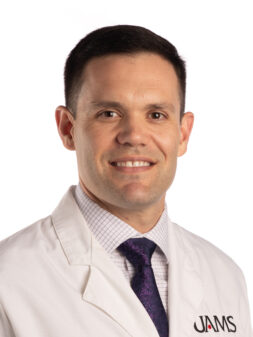
In this video, Dr. Ryan Wood of the UAMS Health Jones Eye Institute explains how specialty lenses, especially scleral lenses, are designed to fit each patient’s unique eye shape and vision needs. These larger lenses rest on the white part of the eye and can provide both improved comfort and clearer vision for patients with complex eye conditions.
Dr. Wood also discusses how specialty lenses can help patients with conditions such as keratoconus, corneal scarring, irregular astigmatism, and severe dry eye disease.
At UAMS Health, each lens is carefully designed and fitted using detailed corneal mapping and advanced diagnostic testing to ensure the best possible vision and comfort.
Video Player

Transcript
Specialty contact lenses range from soft lenses for higher or unique prescriptions to more rigid, small lenses meant for things like corneal scarring or irregular astigmatism. My primary focus is what’s called scleral lenses. A scleral lens is a large, hard lens that sits on the sclera, the white part of the eye. It’s unique because it sits on that white part, which isn’t sensitive, so it can feel just as comfortable as, or more comfortable than, a soft lens. It also helps vault over problems that might otherwise prevent someone from wearing typical glasses or conventional contact lenses.
Specialty lenses differ from conventional lenses in several ways, including shape and material. Commercially made lenses come in generic sizes and prescriptions, but specialty lenses are more like getting a retainer made for your teeth. They’re formed specifically to your eye, and no one else can wear the same lens. Patients come in for follow up visits so we can make adjustments and modifications to help get them the best vision possible.
Scleral lenses in particular are great for vaulting over problems, which could include irregularities patients are born with, such as keratoconus, scarring from previous surgeries or injuries, or something as common as dry eyes where patients are intolerant of how their eyes feel in conventional lenses. Scleral lenses help keep moisture on the surface of the eye, which prevents those symptoms and helps patients see more clearly.
One of the bigger hurdles is that these lenses are often considered medically necessary, an insurance term meaning that other conventional forms of vision correction can’t help that person, so insurance needs to help cover the cost. But anyone can wear them. They can correct a typical prescription, whether nearsighted, farsighted, or astigmatism, and can even help patients who just need help reading. Bifocal or multifocal contact lenses are also available, which can reduce the need for over the counter reading glasses.
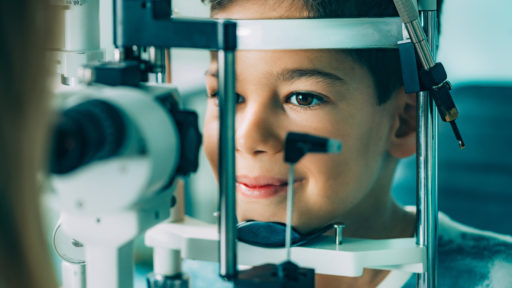
For a specialty lens fitting, we first gather the patient’s baseline information: checking their vision, learning about their history, and examining their eyes. We take detailed corneal maps, sometimes of just the surface and sometimes of all the layers of the cornea, to get specific measurements. Then we apply a test or diagnostic lens to the person’s eye and assess the fit, taking measurements with our equipment to determine what changes are needed. Finally, we perform what’s called an over refraction, dialing in the additional prescription needed in the lens so the person can see clearly through it without also needing glasses.