Description
The treatment of head and neck cancer has changed dramatically over the past several decades. Procedures that once left patients with significant challenges to speaking, swallowing and daily life can now be paired with advanced reconstructive techniques designed to restore both function and appearance.
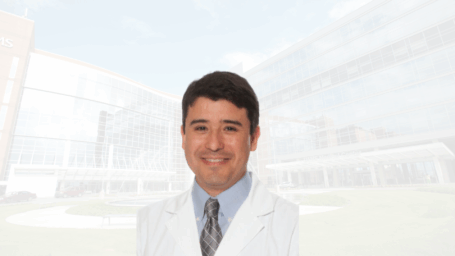
In this video, Dr. Mauricio Moreno, head and neck surgeon at UAMS Health, explains how modern reconstructive surgery is helping patients achieve better outcomes after treatment for complex head and neck cancers. By combining cancer removal with sophisticated reconstructive procedures, many patients are able to return to activities that were once thought impossible after treatment.
Dr. Moreno shares how advances in surgical techniques have expanded treatment options for patients with advanced cancers while preserving quality of life whenever possible. With more than 1,500 complex head and neck reconstructions performed, he brings extensive experience to caring for patients facing some of the most challenging diagnoses.
Learn how innovation, expertise and a multidisciplinary approach are helping transform head and neck cancer care at UAMS Health.
Video Player

Transcript
One of the main things that differentiates modern head and neck cancer care is the addition of complex reconstruction. In previous decades, some of these tumors were by definition disfiguring and massively affected patients’ ability to function. They were unable to talk. They were unable to eat. Today, we have multiple complex techniques that allow us to not only remove the tumor but simultaneously perform reconstruction in the same operation. Most of those patients are able to leave with a normal or near-normal quality of life.
When I was in medical school, we saw patients with advanced tongue cancer where the treatment involved removing the entire tongue — but it was rarely done because the impact on function was so extensive it was considered unethical. We had a tool that could potentially cure the cancer, but the cost to the patient’s quality of life was too high. Today, we treat those patients routinely. We remove the entire tongue and perform reconstruction at the same time. Within a couple of weeks, those patients are talking again — and with aggressive swallowing therapy, many are able to return to some degree of oral diet over time.
Since joining UAMS in 2009, I have been developing complex head and neck reconstruction and have accrued significant experience in these procedures. To date, I have performed more than 1,500 complex reconstructions, and I can assure you that our outcomes are as good as anyone’s in the nation.