Description
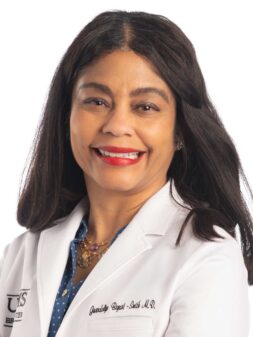
In this Conquering Cancer segment from THV11, Karen Fuller speaks with Dr. Gwendolyn M. Bryant-Smith, the chief of breast imaging at UAMS Health. Dr. Bryant-Smith discusses the critical role of regular mammograms in detecting breast cancer early, explaining how screenings can dramatically improve survival rates by catching the disease before it spreads.
Video Player

Transcript
Karen Fuller:
As you know, each month on Wake Up Central, we bring you stories of Arkansans touched by cancer. But this time we’re looking at ways to prevent it. We sat down with Dr. Gwendolyn Bryant-Smith, the division director of breast imaging at the UAMS Winthrop P. Rockefeller Cancer Institute, to find out more.
Gwendolyn M. Bryant-Smith, M.D.:
There are two types of mammogram exams — a screening mammogram and a diagnostic mammogram.
Fuller:
Dr. Gwendolyn Bryant-Smith oversees breast imaging for the Women’s Breast Center at the UAMS Winthrop P. Rockefeller Cancer Institute, but she’s also a radiologist who reads and interprets mammogram results almost every day.
Dr. Bryant-Smith:
There are four key things that a radiologist looks for on a mammogram. They are masses, asymmetries, architectural distortion, and microcalcifications.
Fuller:
Even the words can sound frightening and worse, to think of how life can change on a dime with an unexpected diagnosis. But Dr. Bryant-Smith says she and her staff understand the fear and anxiety that come with getting a mammogram. She suggests seeing a screening as a positive because of what it can mean if you must battle breast cancer.
Dr. Bryant-Smith:
You should not fear mammography. Mammography is your friend. You want — if there’s something abnormal going on in your breast, you want it to be found by screening. Most cancers found by screening have an extremely good prognosis for survival.
Fuller:
As for screening recommendations, Dr. Bryant-Smith says there is more agreement these days among experts on when to start screening mammograms and how often to get them.
Dr. Bryant-Smith:
Most of the societies are all in agreement that if you’re at average risk for breast cancer, then you should start mammography at age 40. And the Society of Breast Imaging and most other organizations say the best outcomes happen if you do a mammogram every single year.
Fuller:
She says women at a higher risk of breast cancer might begin screenings as early as age 30. But even if cancer is found, the team at UAMS will be ready and waiting to walk you through your journey from start to finish.
Dr. Bryant-Smith:
When we call you, we are immediately getting you set up with our interdisciplinary team, with our breast surgeon for further care. So this is not a you come here and we drop you. We coordinate your care. We have all of these tools available to help you.
Breast cancer is very curable if caught early. So remember that.
Fear and allowing yourself to be paralyzed by fear and not treated, that is the real evil in this whole thing. Because you are not catching it when you should. Don’t fear it. Be in control. Be in control of your health.
Fuller:
She’s right. And there is some good news. Death rates from breast cancer are falling. That’s according to the National Breast Cancer Foundation. Advancements in screenings mean more cancers than ever are being diagnosed before they can spread to other parts of the body.