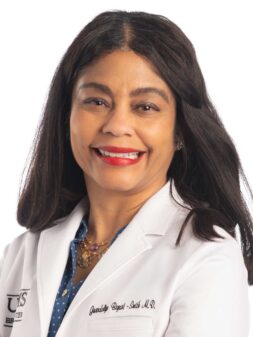
Description
Video Player

Transcript
We recommend screening mammography in the average-risk individual at age 40.
When do you screen before age 40? That is determined based on your age, your family history, and whether you have any risk factors that would put you at a higher risk of having breast cancer before 40.
Mammography is an early detection tool. It finds things that we can’t feel, and that’s what we hope. But most women are aware of their bodies. So if you are 30, you don’t need to wait to 40. You go in and you see your primary care doctor and say, “I feel a lump. What should I do?” They’re going to say, “Oh my gosh—let’s get a mammogram. Let’s do an ultrasound.”
So you may come to my clinic. They may say, “I’m going to send you to Dr. Henry Tilman.” If you’re 30, they’re most likely going to send you there first and say, “Dr. Tilman, can you evaluate this?” And I would say, “Yes—you’re 30. Let me ultrasound you.”
If the ultrasound shows that you have a solid mass or a cystic mass, I may aspirate it. I may biopsy it. If it’s cancer—or if it’s a fibroid—I may remove it. If you’re 40, or if you’re low risk, I may order a mammogram. I would then call my radiology colleagues and say, “I have a young woman that’s 30. She’s not at the age of screening, but she needs a diagnostic mammogram because she has a mass.” And then Dr. Gwen Bryant would do that test.
The other way a patient would come in is that they’re in their primary care doctor’s office and they’re 40, and they order a screening mammography. They may not ever see me. They may get their mammogram. If they’re normal, they go back to their primary care doctor. The results are given to their primary care doctor.
Or they may be 40 and Dr. Gwen Bryant—one of our radiologists here, a part of our breast team—says, “She has an abnormality. I would like to recommend a test to do a biopsy.” If it’s cancer, then they’ll refer them to see me, which I will plan the treatment with my team.
We make a multidisciplinary decision on the type of cancer, what are the needs of the patients, and what we need to do.