• Skip to primary navigation
  • Skip to main content
  • Skip to primary navigation
  • Skip to main content
Choose which site to search.
UAMS Health Logo UAMS Health
  • UAMS.edu
  • MyChart
  • Giving
  • Emergency Room
  • Types of Care
  • Locations
  • Doctors
  • Patients and Guests
  • Referring Physicians
  • Appointments
  • About Us
    • Awards and Recognition
    • Clinical Trials
  1. UAMS Health
  2. Clinical Resources
  3. Understanding Breast Health & the Importance of Screening

Clinical Resource: Understanding Breast Health & the Importance of Screening

Description

Breast health matters for everyone. In this video, a UAMS Health expert explains what breast disease means, the difference between benign breast conditions and breast cancer, and why not every lump is cancer — but every change deserves attention. Learn about common causes of breast pain and masses, including cysts and benign tumors, and how breast cancer is diagnosed through imaging and pathology. The video also highlights the importance of knowing your family history, understanding your personal risk, and following screening guidelines. While mammography doesn’t prevent breast cancer, it plays a vital role in early detection. For those at average risk, screening should begin at age 40, and individuals with a family history should talk with their primary care provider about earlier screening. You’ll also hear how breast cancer care is delivered by a multidisciplinary team dedicated to providing comprehensive, life-saving treatment.

Video Player

Understanding Breast Health & the Importance of Screening with Dr. Henry-Tillman at UAMS Health

Transcript

As a woman and as a male, we all have breasts. The breast is an organ that sits on your chest wall. So breast disease is any condition that occurs in your breast.

Some people can have breast pain. It doesn’t mean breast cancer. Some people can have a breast mass. It doesn’t mean breast cancer. A breast mass can be a cyst. It could be a benign tumor like a fibroadenoma. It can be a high-risk lesion with atypical cells and not be breast cancer.

Breast cancer is actually the diagnosis that is obtained from an abnormality in the breast—either found by the individual as a lump or findings on mammography—and the pathologist takes a look at it and says you have a type of breast cancer.

Every lump isn’t breast cancer, but every lump can be something. And so I always tell individuals: understand your breast health, know your family history, understand the guidelines that are required.

Mammography doesn’t prevent breast cancer. Mammography detects breast cancer.

Treatment of breast cancer requires a plethora of individuals—not just me, but a group of people that come together that provide you with the treatment to save your life.

And so, we all have breasts. Not everyone is going to have breast cancer, but you need to know if you’re average risk—meaning you don’t have any family history, you don’t have any exposures—get your mammograms at age 40. Get screened.

If you have a family history, talk to your primary care doctor about when’s the best age for you to get screened.

Related Content

  • Conditions
  • Treatments & Procedures
  • Providers
  • Areas of Expertise
  • Make an Appointment

Related Conditions

  • Breast Cancer

Related Medical Treatments and Procedures

  • Breast MRI
  • Mammogram

Related Providers

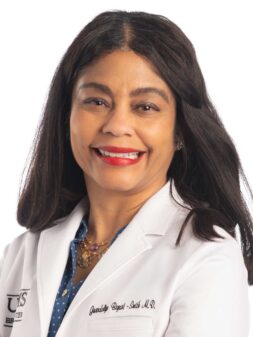
Gwendolyn M. Bryant-Smith, M.D.

Gwendolyn M. Bryant-Smith, M.D. Diagnostic Radiologist

View Profile

Related Areas of Expertise

Breast Cancer Care (Part of Cancer Care)

No one wants to hear they have breast cancer, but the good news is more women are living longer and healthier lives with breast cancer.

View Area of Expertise

Breast Care (Part of Women's Health)

From yearly exams to the most technical specialized procedures, our doctors provide a personalized treatment plan for you

View Area of Expertise

Make an Appointment

Request an appointment by contacting a clinic directly or by calling the UAMS Health appointment line at (501) 686-8000.

UAMS Health LogoUAMS HealthUniversity of Arkansas for Medical Sciences
Mailing Address: 4301 West Markham Street, Little Rock, AR 72205
Phone: (501) 686-7000
  • Facebook
  • X
  • Instagram
  • YouTube
  • LinkedIn
  • Disclaimer
  • Terms of Use
  • Privacy Statement
  • Notice of Privacy Practices
  • Price Transparency
  • Legal Notices

© 2026 University of Arkansas for Medical Sciences