
Initial Contact
In early 2024, a 77-year-old Hot Springs Village woman with Lynch Syndrome, a hereditary syndrome that greatly increases the risk of developing certain types of cancer, was referred by another hospital in Arkansas to A. Murat Aydin, M.D., a urologic oncologist at the University of Arkansas for Medical Sciences (UAMS). Over the past two decades, the patient had experienced bladder cancer, reoccurring left ureter cancer, colon cancer and uterine
cancer, resulting in the removal of her right distal ureter, colon and uterus. Now, she had two very large tumors in her kidneys, despite having undergone several laser ablation treatments, partial tumor removal, systemic chemotherapy and immunotherapy. “So she was sent to me for essentially the removal of both kidneys, and then she was to start dialysis, because they had
exhausted their options, they thought,” Aydin said.
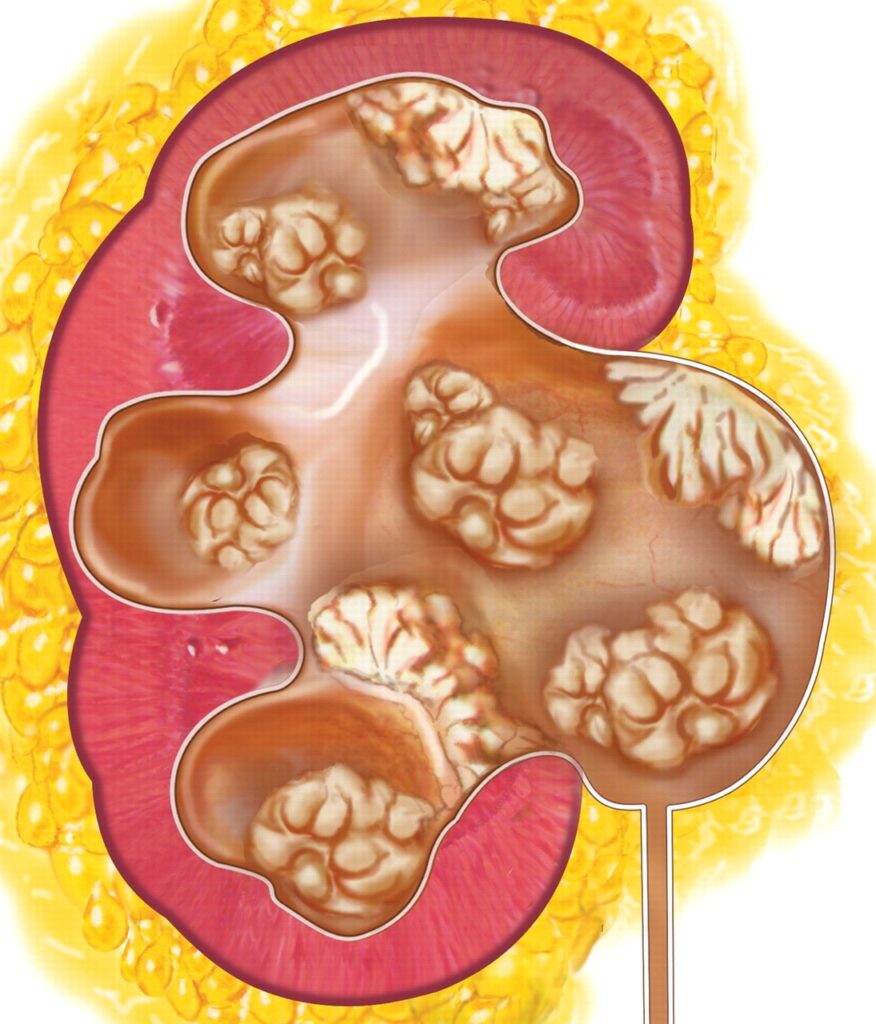
An example of high-volume urothelial tumors in the kidney.
Assessment
Aydin said the patient had high volume, low-grade urothelial cancer. High volume tumors can be more difficult to treat and may require treatments that are more aggressive, such as total kidney removal. He said he first performed laser ablation on both kidneys, a process that took about an hour while the patient was under general anesthesia, “but this was not enough, because it was very high volume and you cannot eradicate it with just laser.”
“You can laser some tumors, but they start to bleed, and obscure your endoscopic vision as well,” Aydin said. “Essentially, you cannot eradicate all tumors using laser.”
Procedure
He then decided to use a novel treatment known as Jelmyto, which had never been used before at UAMS. It is an innovative gel form of chemotherapy used specifically for low-grade Upper Tract Urothelial Cancer that was approved in
2020 by the U.S. Food and Drug Administration (FDA). This required him to schedule the patient for placement of a percutaneous nephrostomy tube
in her left kidney at the UAMS Interventional Radiology laboratory, where Adam Berry, D.O., specializes in interventional radiology procedures for a broad range of conditions. Four weeks after the tube was placed, the patient returned to UAMS, this time to the infusion center in the Winthrop P. Rockefeller Cancer Institute. There, she received the first of her five weekly
outpatient treatments on her left kidney with Jelmyto. The medication
combines the chemotherapy drug mytomycin and a chilled liquid.
Aydin said it is injected directly into the kidney through the nephrostomy
tube — a process known as instillation. As it warms to body temperature,
it hardens into a gel. Then, because it is in gel form, the medication stays
in the kidney for much longer than liquids, up to six hours, filling hard to-reach places in the upper urinary tract without quickly flushing out of the kidney like other traditional chemotherapy agents. It then slowly liquefies and passes naturally through the system, exiting the body through urination.
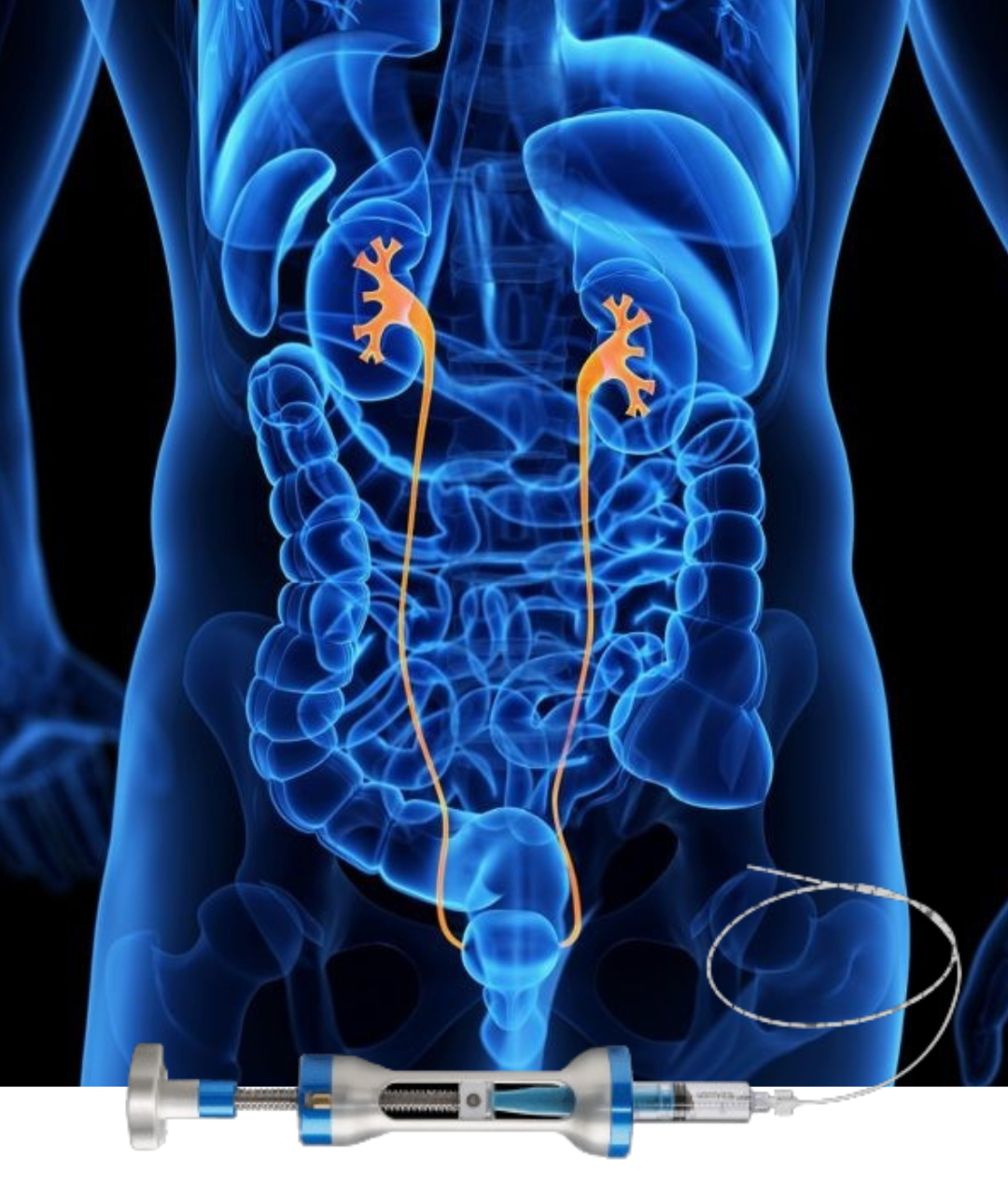
A depiction of the Jelmyto device and how it works.
After the first five treatments, which took about 15 minutes each and required no sedation, the patient returned to Interventional Radiology to have the nephrostomy tube in the left kidney removed, and a nephrostomy tube placed into her right kidney. She again waited four weeks after the tube placement before returning to the Cancer Institute to begin her additional weekly Jelmyto instillations in the right kidney. Aydin said Jelmyto instillations are typically given once a week for six weeks, but this patient had an infection that reduced her treatments to five in each kidney.
Follow-up
Endoscopies performed in October 2024 and again in January 2025 found no residual tumor at all, indicating complete treatment response, and a May 2025 CT scan confirmed that the patient remained tumor-free. “This is a miracle,” Aydin said. “She came to UAMS with two very large tumors, in both her right and left kidneys, which is rare. She was supposed to undergo total kidney removal on both sides, and undergo dialysis afterwards, since laser and medical therapies failed. However, we were able to give her this new chemotherapy agent through the tubes, and now she has been tumor-free for more than 12 months. Her treatment ended last summer, and she hasn’t had any issues since then.” He added, “We expect this not to come back, but she hasLynch syndrome, which makes her prone to developing these cancers. So, if she has a tumor occurrence down the road, we will again try to use this novel treatment to spare the kidneys.” He said the patient, now 78, returns to UAMS for CT scans and endoscopies in regular intervals for close monitoring.
Discussion
Aydin said the Jelmyto treatment is covered by insurance but isn’t widely available in Arkansas because it requires coordinated, multi-disciplinary expertise and specific infrastructure. He said the UAMS Cancer Institute is well positioned to provide Jelmyto with a specially trained team of doctors and nurses. “We know that many doctors are not aware of this novel treatment provided at UAMS,” he said. “There should be more public awareness of this.”
Aydin also said that this patient’s case was unique. “Usually, upper tract urothelial tumors happen spontaneously in only one kidney,” he said. “This patient had tumors in both kidneys. They were very large. She already failed chemotherapy, immunotherapy and other options, such as laser ablation.
Her only other choice was total kidney removal and dialysis afterwards. Because her tumors were very large, we didn’t know how she would respond, but fortunately, the gel chemotherapy stuck to the tumor and really melted the entire tumor — got rid of it.
Referrals
To refer a patient to Aydin, call 501-686-5655 or send an email to Tsparks3@UAMS.edu.