Description
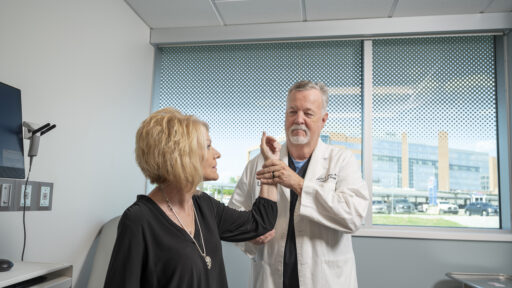
Dupuytren’s disease is a common, benign condition that can cause the fingers to curl down over time, making it hard to straighten your hand or perform everyday activities. In this video, Dr. Theresa Wyrick, orthopaedic hand and upper extremity specialist at UAMS Health, explains what causes Dupuytren’s disease, how it progresses, and when treatment is needed. She also describes a non-surgical, office-based injection therapy that helps break down the tissue causing finger contracture — without the need for anesthesia or a long recovery. Learn how this innovative treatment works, what to expect, and why early evaluation is key to maintaining hand function.
Video Player

Transcript
Dupuytren’s disease. A little bit of background on that. It’s actually a really common condition. It’s one of the more common things that I see in my office. It’s a benign process and the patient will develop um as they age these sort of lumps or nodules in the palm. It’s not a painful condition. It’s not harmful. It’s not a cancer or a tumor or anything concerning in that way. The
main thing that happens is it starts to draw the fingers down over time such that initially you can get your hand flat but as this condition develops the fingers can start to draw down and you can’t actually straighten them and so this affects your function. There is no cure for Dupuytren’s disease because it’s strongly genetic. And so it’s a little bit of a tricky disease in that
if you surgically take out the bumps or nodules that can actually stimulate the disease process to accelerate. So you take out a nodule but then the areas around it become more active with the disease. It’s one of those things that we don’t want to tackle surgically right away unless there is a true symptom because it can accelerate the disease process in the surrounding tissues. Also, taking out a nodule surgically is not a cure for the condition because it’s genetically rooted and so it will just um potentially come back in the area. So, all of that discussion kind of comes into the treatment plan. Um, so if the patient can still get their hand flat on a table, we call it a very simple tabletop test where you place the hand flat on the table. If you can get the hand flat on the table, then you’re good. You don’t need any sort of intervention or treatment. But it’s when you can’t get the hand flat on the table, that’s when we start thinking about interventions. Some people ask about um stretching or therapy or splinting as sort of a preventive measure. Those things so don’t don’t seem to be helpful at preventing the progression of the disease. Um, it can make it feel less tight or it can make you feel like you’re doing something and it’s certainly not harmful to stretch the fingers when they feel tight, but it doesn’t seem to halt the progress of the disease. And so what we’re monitoring is when and if the patient starts to develop that contraure, that situation where they can’t physically get the hand flat on the table. And this becomes difficult with simple things like putting on a glove, putting your hand in your pocket, getting your hand flat on the floor to do yoga or to do a push-up or some sort of physical activity in that way. I think specifically with the injection, it doesn’t require an anesthesia. It’s all done with the patient awake and in the office. It does require a series of two injections. One injection is when we actually inject the medicine in the disease. The medication is a really unique compound. It’s an enzyme and it’s chemically targeted to digest, dissolve, break down a portion of the Dupuytren’s disease. And so we inject it into the area of the nodule in the patient’s hand in the office. And then most patients have a pretty significant reaction to it,
including bruising, swelling, pain. Nothing that’s severe or not manageable, but some pain afterwards. But they’re able to use the hand right away. They don’t have any sort of cast, incision, immobilization, any of those things that would slow them down. Just a little bit of soreness after the injection. And then we give the medication a period of time to work to dissolve, digest, break down the Dupuytren’s disease. And then they return to the office also just fully awake with some numbing medication. We then take advantage of what that medication has been doing with the Dupuytren’s disease over that preceding time since the injection. Typically the manipulation portion, this second portion is done somewhere between 1 and 7 days after the original injection. They are required to have one visit with therapy. We make a brace at that time that holds the finger straight, but they only have to wear that at night for 30 days after. They’re brace-free during the day. So, with the injection, the non-surgical treatment, the 5-year data says that about 40 to 45% of patients will experience some recurrence. The good news is that if it does recur, then they could still be a candidate for a repeat injection.