Description
In this video, we break down one of the most common questions patients ask: What is the ACL, and do you really need it?
An orthopaedic specialist explains the role of the anterior cruciate ligament (ACL), how it stabilizes the knee, why ACL tears often occur during twisting or pivoting sports, and the symptoms patients typically experience after injury — including swelling, instability, and a “popping” sensation.
We also discuss who truly needs ACL reconstruction and who may be able to successfully manage an ACL tear without surgery through physical therapy and muscle strengthening. Whether you’re an athlete or someone who simply wants to stay active, this video helps you understand how the ACL functions and what treatment options might be right for you.
Video Player

Transcript
So one of the most common questions I get asked is, what is the anterior cruciate ligament, or what is the ACL? And I always tell patients you have four major ligaments in your knee — two on the outside called collaterals, and two that cross on the inside. That’s where we get the name “cruciate” from — called your anterior cruciate ligament and your posterior cruciate ligament.
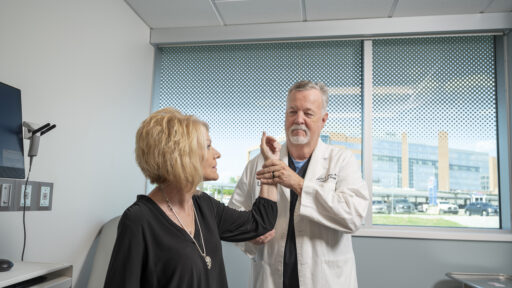
I have the medical students that work with me do this with their fingers because that’s the exact orientation they run in your knee.
The ACL does two major things for your knee: it prevents your shin bone from coming forward, and it also helps stabilize your knee when you twist.
So commonly when patients tear their ACL, what they complain of is feelings of instability, or “my knee gives out when I turn.” And it’s particularly after an injury, often when playing athletics, where the knee will get big and swollen after feeling a pop.
Does everyone need an ACL? No. Only patients that do a lot of twisting activities or activities that involve cutting and pivoting rely heavily on their ACL.
So the decision to proceed with ACL reconstruction is based on the patient: What do you do? What do you like to do? What do you want to get back to doing? Because if you’re going to twist and cut a lot, you need that ACL to prevent your knee from hurting other parts of your knee like your cartilage or your meniscus.
If you just want to walk straight ahead or maybe lightly jog on the treadmill, we can try non-surgical management like physical therapy to strengthen the muscles around your knee.