Description
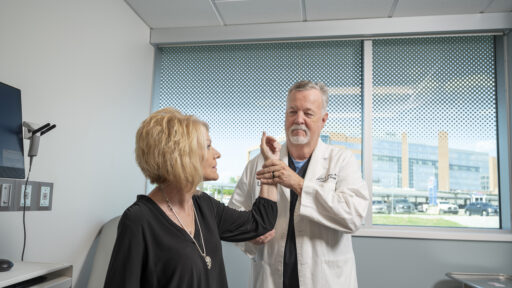
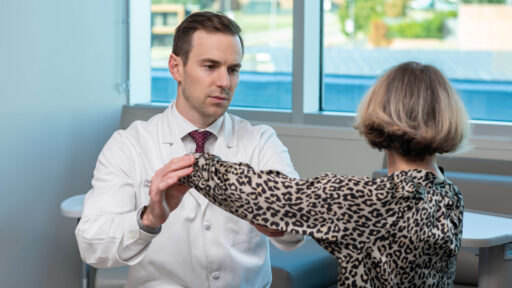
Dr. J. Ryan Hill, a fellowship-trained orthopaedic surgeon at UAMS Health, explains shoulder laxity and multidirectional instability as conditions that exhibit a wide spectrum of different clinical forms and the treatment options available to patients.
Video Player

Transcript
n addition to instability of the shoulder that can be traumatic, there are also patients who just have loose ligaments or loose tissues that surround and stabilize their shoulder.
For those patients, sometimes they may experience instability—whether that’s a dislocation, or simply feeling like their shoulder is loose or sliding around—without really having an injury or trauma.
Thankfully, we do have treatment options even for those patients. A lot of that consists of very specific and detailed rehab that helps the muscles supporting and stabilizing the shoulder essentially relearn how to properly activate and fire. The goal is to restore stability and give them back the functional range of motion that a normal shoulder would have.
Now, sometimes when that’s unsuccessful, surgical procedures may be needed. Those can involve tightening some of the loose structures around the shoulder.
In certain cases, we also need to add more stability by addressing the shoulder’s bony structures. Those situations can require more complex reconstructions—procedures that we are happy to take care of, and that are very rewarding for us to perform as well.