Description
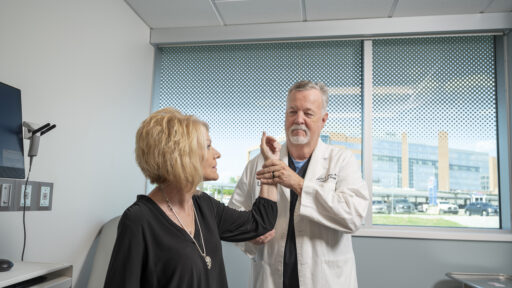
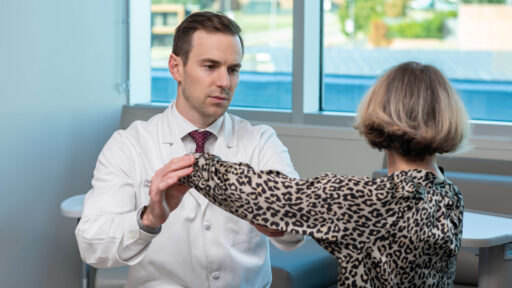
Dr. J. Ryan Hill, a fellowship-trained orthopaedic surgeon at UAMS Health, explains shoulder instability, including the causes, diagnosis and treatment options available.
Video Player

Transcript
One of the common things that we see in our clinics, and that we really enjoy treating, is shoulder instability.
It’s a very common problem because the shoulder joint itself is inherently unstable. It has a lot less bony constraint than other joints in the body, so it really relies on the muscles, tendons, and ligaments surrounding it, as well as something called the labrum. The labrum is a thickening of tissue that surrounds the socket.
Essentially, the shoulder joint is like a golf ball sitting on a tee.
So, when we have younger athletes, higher-level athletes, doing activities with their arms away from their body, if any trauma happens in those positions, it can cause the ball to slide out of the socket. When that happens, it tears some of those structures—most commonly either the capsule or the labrum.
When we see patients with these problems, there are several things we have to take into consideration. There’s the injury to the soft tissue structures, but depending on the trauma, sometimes the bony structures can be involved as well. That helps us determine the best treatment for each patient.
Some patients can do okay without surgery. But we know that younger, higher-level athletes are prone to having more dislocations in the future. We want to prevent not only the pain of those injuries, but also the long-term consequences—like developing arthritis earlier than they otherwise would.
Treatment options really depend on the injury. Sometimes we can do an arthroscopic procedure, which is minimally invasive. Through small incisions, we use a tiny camera to fix structures like the labrum, capsule, and ligaments. Other times, if the bone has been compromised, patients may need a larger open surgery. That might involve using bone from elsewhere in the body—or from a donor—to build the socket back up and restore stability.
Even with those open procedures, patients do very well. We’re usually able to get people back to their activities—whether that’s labor-intensive work or high-level athletics.
It typically takes about four to six months, but most patients are able to return to the things they need or love to do.