Description
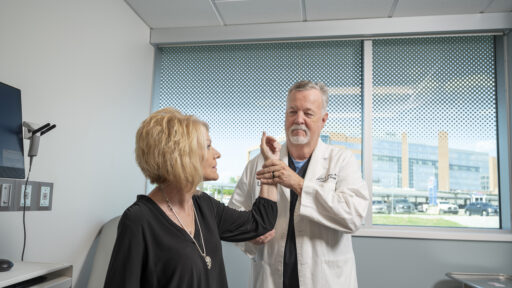
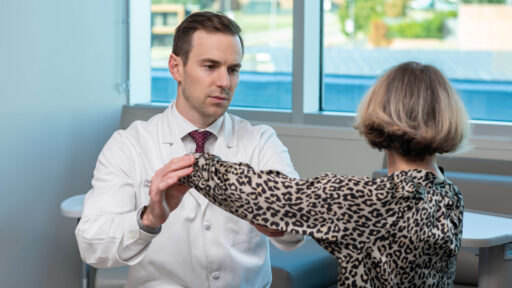
Dr. J. Ryan Hill, a fellowship-trained orthopaedic surgeon at UAMS Health, discusses shoulder arthritis and treatment options available.
Video Player

Transcript
Another common thing that we see patients for in our Clinic is shoulder arthritis which is essentially loss of
the smooth gliding surface that allows our joints to move how we like them to without pain and through a full range of
motion especially for the shoulder that has more motion than any other joint in the body and arthritis is essentially
the loss of that surface which is called cartilage and you can lose it on both sides both at the socket and at the ball
portion of your shoulder so we have many different treatments that we can use when people come in with an arthritic
shoulder our goals are to help them with pain relief and hopefully help them get a little bit of their motion back and
things that we can do for that are simple things like anti-inflammatory medications some in some cases physical
therapy and for some people a steroid injection into the shoulder can be very effective for their pain relief; however, arthritis progresses with time and at at a certain point those conservative measures only provide people with so much pain relief and also those conservative measures can only do so much to get some of that motion back so when we have arthritis in the shoulder uh we always need to look at what the rotator cuff looks like because those are the small muscles that are essential for helping the shoulder function like it’s supposed to when those muscles are intact and healthy
then what our treatment option for that is is called an anatomic total shoulder arthroplasty and the reason why it’s
called that is because we put the parts back in just how they were before they developed arthritis so when that gets to
a severe point where the patient’s quality of life is limited by these things then we begin to talk about a shoulder replacement and what that involves is basically taking out those arthritic surfaces that can no longer glide smoothly on each other and replacing them with metal alloys and with high-grade medical plastic and it allows those surfaces to regain that smooth motion that the shoulder used to have before the arthritis developed you can see that here on this model this is the humoris which makes the ball part of the shoulder joint and then the uh scapula which makes the glenoid or the socket part of the shoulder joint and what we do is essentially take off the ball that was bone that had arthritis and bone spurs we replace it with a metal head and then on the socket side we basically resurface that and then put in this high-grade medical plastic that allows the shoulder to then glide and move like it did previously.